Wednesday, May 22, 2013
Mercedes Benz Launches Viano Avantgarde Edition car features and reviews
 |
| Mercedes-Benz Launches Viano Avantgarde Edition car features and reviews |


Monday, May 20, 2013
How to Reset a Flexible Service System in a Mercedes C280
1998-2002 Vehicles
1. Turn the ignition to the On position but do not start the vehicle.
2. Press the FSS button twice within four seconds. The button may have a 1 or a 0 imprinted on or near it. This will show the days or mileage remaining until the next service is due.
3. Turn the ignition key to the Lock position within 10 seconds. This is one position back from the On position.
4. Depress and hold the FSS button while turning the ignition to the On position. Do not start the vehicle. This will show the days or mileage remaining until service is due again. Continue to hold the button for 10 seconds until you hear a tone. The display will indicate 10,000 miles and 365 days to next service.
5. Release the FSS button and turn the ignition to the Lock position. The reset procedure is now complete.
2003-2007 Vehicles
6. Turn the ignition to the On position but do not start the vehicle.
7. Press the FSS button for about three seconds. The display will read: DO YOU WANT TO RESET THE SERVICE INTERVAL? CONFIRM BY PRESSING R, or it will read, SERVICE INTERVAL? RESET WITH BUTTON.
8. Press and hold the FSS reset button until a tone sounds. The FSS will now display the reset interval.
9. Release the FSS button then turn the ignition off. The reset procedure is now complete.
Sunday, May 19, 2013
2010 Mercedes C63 AMG Facelift With 7 Speed Transmission

Saturday, May 18, 2013
How to Remove the Door Trim on a 1990 300E Mercedes Benz
1. Warm up the heat gun by turning it on and letting it stand for a few minutes.
2. Run it back and forth over the trim but not touching it. Just enough to soften up the adhesive backing.
3. Set a cloth under the beginning part of the trim and slide the trim removal tool along the cloth and up under the trim to pry it up.
4. Work the removal tool and the cloth along the entire length of each piece of trim to pry it off the vehicle. Do this carefully if you wish to reuse the trim because it can crack or chip easily.
5. Pull the trim gently away from the vehicle door and set it aside.
Friday, May 17, 2013
2012 Mercedes C Class Coupe

Mercedes-Benz has released the first details and images of the upcoming 2012 Mercedes-Benz C-Class ahead of its Geneva Motor Show launch next month.
The new model isnt Benzs first attempt at crafting a C-Coupe, but it is a remarkably different approach. Unlike the C-Class Sportcoupe hatchback, sold here from 2002 to 2007, the new two-door C-Class isnt a basic, entry-level luxury compact. Instead of competing against Audi A3s, this C is gunning directly at BMWs 3-Series Coupe.
Exterior styling is certainly handsome, if not predictable. The new C-Class Coupe is almost the splitting image of the C-Class sedan, and even uses the same front fascia and fenders as its four-door siblings. Coupe models do receive a sweeping panoramic glass roof thats nearly an inch and a half lower than the sedan, and incorporates a very BMW-like kick in the quarter window design.
Inside, the cabin echoes the rest of the C-Class lineup and comes nicely equipped with a flat-bottom steering wheel, aluminum trim (Burl Walnut and Ash Olive Matte are also available), metallic accents, and a 5.8-inch COMAND display. Options include heated front seats, a Harman/Kardon audio system, and GPS navigation.
The engine lineup should mirror that of its Sedan sibling too, including the new four-cylinder engine in the C250 Sport. This means that the base engine for the C-Class Coupe will come with a 201 horsepower 1.8-liter turbocharged four-cylinder mill. It will be positioned below a V-6 model equipped with a 302 horsepower 3.5-liter engine thats claimed to be capable of sub 6.0 second 0-60 mph sprints and a fuel economy of 34.6 mpg for the European cycle.


Press Release
World premiere in Geneva
- In a class of its own: expressive, dramatic coupe design
- Drive and vigor: two powerful direct-injection engines to choose from
- Helping hand: numerous assistance systems available
- Connected: new generation of telematics
The new MY2012 Mercedes-Benz C-Class Coupe will debut at the Geneva Motor Show on March 1 and make its way to U.S. showrooms in September. The 302-hp C350 and 201-hp C250 include the progressive technology featured on the upcoming MY2012 C-Class sedan, but packaged in a coupe design that combines pure driving fun with exemplary efficiency.
"By extending the C-Class portfolio, we are consciously targeting new customers," says Dr. Joachim Schmidt, Head of Sales and Marketing at Mercedes-Benz Cars. "The new model is youthful, stylish and expressive. What we are offering is an exceptionally sporty way to enter the world of the Mercedes-Benz coupe."
Dramatic design with classic coupe proportions
From the side, the new coupe captivates the onlooker with its compact proportions, low silhouette (1.5 inches flatter than the sedan) with powerful shoulders and a narrow C-pillar in a classic three-box design. Typical coupe features include the short front overhang, long hood, steeply raked windshield and long, sloping roof. The greenhouse extends far beyond the rear axle to an aggressive short rear end.
While the wedge-shaped, sloping beltline provides a link to the C-Class sedan, its strong upsweep into the C-pillar is an entirely distinctive element. This part of the beltline trim moves sharply upwards to meet the roofline trim and not only adds an aggressive touch to the side windows but also enhances the powerful shoulders.
Front and rear: truly a coupe, truly C-Class
At the front, the new coupe shares the same styling as the latest C-Class sedan and yet still has its own personality. The front view is dominated by the prominent radiator grille surround including the bumper. The center air intake opens upwards, forming a visual base for the radiator grille, which has the double-louvre style typical of a coupe. Two chrome louvers extend on either side of the central star, tapering off at the outer edges and creating an aggressive, arrow-shaped horizontal sweep which gives the front end a pronounced V-shape.
This continues into the side sections which extend from beneath the headlamps and blend into the feature lines along the vehicles length, thereby linking the front end with the sides. The side air intakes in the bumper featuring integrated horizontal daytime running lamps are positioned low, giving the coupe a road-hugging appearance. The shape of the clear-lens headlamps creates a dramatic impression, and acts together with the hood, radiator grille and bumper trim to reinforce the pronounced front section.
From the rear, the new C-Class Coupe looks athletically compact. The appearance of length is reduced by the flowing roof beyond the rear axle, steeply raked rear window and fluid C-pillars. A wide groove at the top of the trunk lid, which is based on the side panel, emphasizes the rears compactness. Positioning the tail lights as far apart as possible emphasizes width. This particular impression of depth is achieved by a centrally located LED indicator, which appears to float in front of the red upper and lower lights with their more deeply set LEDs. Continuous, horizontal light-catching contours in the bumper further accentuate the broad, deep-set effect. A diffuser towards the bottom of the rear bumper between the tailpipe trim makes the rear end look lighter and gives the vehicle a distinctively sporty and dramatic quality.
Highest quality with exclusive color accents
The instrument panel features three tube rings with a metallic finish, the new three-spoke steering wheel features a flat bottom and comes standard with shift paddles. The surfaces of the controls are finely detailed and metallic. The stepped top of the dashboard also accommodates the standard 5.8-inch central display and continues onto the front passenger side as a discreet light-catching contour. The central, trapezoidal air vents and the round vents on the outside are highlighted in detail by metallic trim. The control panel of the new center stack has silver-colored keys, while the combination of matte keys, high-gloss areas and a new controller knob design underline the high quality of the interior.
A large section of trim highlights the dashboard, extending from the center air vents across the front passenger side to the outer air vent, emphasizing the interiors generous proportions. Aluminum trim is standard on the C250 Coupe, while the C350 Coupe features rich Burl Walnut. Unique Ash Olive Matte Wood Trim is optionally available.
The C-Class Coupe is a fully fledged four-seater featuring four sporty, comfortable seats with integrated headrests. If desired, the backrests in the rear can be folded to extend the storage area.
Enhanced telematics with more ease of operation and attractive good looks
The C-Class Coupe features the new telematics generation. Major new features include greater operating convenience, larger displays, phone book transfer, wireless Bluetooth audio streaming and a USB interface now located in the center armrest.
Integrated services include SIRIUS weather information and a special destination search via Google, as well as the option of downloading a route that has been previously configured on a PC using Google Maps and sent to the car. The optional COMAND navigation system also has a new 3D display with city views.
Driving routes covered can now be recorded and recalled later, specific personal destinations can be saved or imported via an SD card and four alternative routes can be displayed on the navigation map including an especially economical route.
Plenty of performance, low fuel consumption
There is a choice of two new direct-injection gasoline engines to power the C-Class Coupe and both models are equipped with a more fuel efficient 7-speed automatic transmission.
The V6 gasoline engine in the C350 features the efficient BlueDIRECT injection and delivers 302 hp and 273 lb-ft of torque. Average combined fuel consumption is 22 mpg (estimated). The four-cylinder gasoline engine in the C250 also features direct injection and is turbocharged, offering high performance and exemplary economy.
The engines for the C-Class Coupe:
rpm
at rpm
mph
mileage
mpg
2,200 - 4,300
24 comb. (est.)*
3,500 - 5,250
(est.)*
Chassis: agile handling and a high level of comfort
The standard AGILITY CONTROL suspension complements the dynamic engines to perfection. This is based on an amplitude-dependent damping system: when driving normally with low shock absorber impulses, the damping forces are automatically reduced for a noticeable improvement in road noise and tire vibration - but without any compromise in handling safety. When shock absorber impulses increase, for example when cornering at speed or performing evasive maneuvers, the maximum damping forces are set and the car is effectively stabilized. The AGILITY CONTROL suspension is complemented by a rack-and-pinion steering system.
Precision suspension: three-link front axle, multi-link independent rear suspension
The front axle has a three-link construction with McPherson spring struts. The lower control arm consists of two separate elements which serve as torque and cross struts and are both made of aluminum. The third link in the front suspension is the tie rod which connects the transverse steering gear to the wheels. The reinforced anti-roll bar is connected to the spring strut which is likewise actively involved in directing the front wheels.
With multi-link independent rear suspension, the wheel is attached to five flexibly mounted, independently acting control arms which restrict five of the available spatial movements: thanks to this intelligent control arm construction each rear wheel basically retains freedom of movement in one plane only, namely during controlled compression and rebound.
Driver assistance systems provide warnings and intervene
With nine airbags as standard, belt tensioners and belt-force limiters for all seats, the C-Class Coupe has extensive safety features. The airbags, which can deploy in milliseconds in the event of an accident, include front, side and pelvic airbags for the driver and front passenger, a kneebag on the drivers side, and headbags. The side protection system - comprising headbag and thoraxbag - optimizes the level of protection afforded to individual parts of the body.
With a number of driving assistance systems ranging from standard ATTENTION ASSIST drowsiness detection to optional Lane Keeping Assist, the coupe provides a comprehensive level of driver support and protection. The assistance systems are based on the latest radar, camera and sensor technology, and cover frequent accident causes such as distraction, fatigue and darkness.
Assistance systems at a glance:
- Anti-lock braking system ABS
- Adaptive Highbeam Assist
- Lane Keeping Assist
- Blind Spot Assist
- ATTENTION ASSIST
- Electronic Stability Program ESP®
- Bi-Xenon headlights with active curve illumination
- PARKTRONIC with Parking Guidance
2012 Mercedes Benz SLK55 AMG

Mercedes-Benz has unveiled the new 2012 SLK55 AMG. which will debut at the Frankfurt Motor Show,
Dubbed the SLK55 AMG, the new car boasts a 5.5-liter V8 that cranks out 415 horsepower at 6,800 rpm and 398 lb-ft. of torque at 4,500 rpm, good enough to help the little droptop scoot to 60 mph in a mere 4.5 seconds before topping out at an electronically limited 155 mph.
The special feature of the SLK is the cylinder deactivation: If the full power of the engine isn’t necessary, it is able to shut off 4 cylinders -giving fuel savings over 30 percent. The cylinder deactivation can be switched within 30 milliseconds and provides 230 Nm of torque and has 800-3600 U / min available when the driver activates “C” Controlled Efficiency.
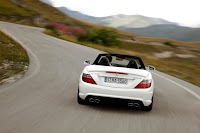
An AMG body kit includes a new front apron with larger air intakes and LED running lights, dark-lens headlamps, side vents with chrome-plated fins, side sills, rear lip spoiler and rear apron with a black diffuser.
According to the Mercedes, the new SLK 55 AMG completes the standard 0-100km/h (62mph) sprint in 4.6 seconds and reaches an electronically limited top speed of 250km/h (155mph).




Press Release
The 2012 Mercedes-Benz SLK55 AMG is the most powerful SLK of all time. Its new AMG 5.5-liter V8 engine featuring cylinder shutoff combines the ultimate in performance with the lowest possible fuel consumption. With a peak output of 415 hp and maximum torque of 398 lb-ft, the 2012 SLK55 AMG is poised to outperform all of its direct competitors. High-performance driving is ensured thanks to the AMG sports suspension with Direct-Steer system, Torque Vectoring Brakes and 3-stage ESP®, as well as the AMG high-performance braking system. The 2012 SLK55 AMG will arrive in U.S. showrooms in early 2012.
Forming part of the third-generation of the SLK launched in June, the new AMG model catches the eye at first glance: distinctive AMG light-alloy wheels, exclusive AMG body styling with AMG spoiler lip and two chrome-plated twin tailpipes at the rear complement the classic roadster proportions, while adding a distinct athletic touch. The expressive design of the 2012 SLK55 AMG is both eye-catching and unmistakable.
The SLK55 AMG is the perfect embodiment of the new AMG brand claim of “Driving Performance”: in the compact high-performance Roadster segment there is nothing to compare to its combination of tangible driving dynamics, superior sportiness, unique high-technology and low fuel consumption. The SLK55 AMG accelerates from zero to 60 mph in 4.5 seconds, and reaches a top speed of 155 mph (electronically limited).
Key figures at a glance
| 2012 SLK55 AMG | |
| Displacement | 5,461 cc |
| Bore x stroke | 3.86 in x 3.56 in |
| Compression ratio | 12.6 : 1 |
| Output | 415 hp at 6,800 rpm |
| Max. torque | 398 lb-ft at 4,500 rpm |
| Engine weight (dry) | 412 lbs |
| Acceleration | 0 – 60 mph 4.5 s |
| Top speed | 155 mph** |
| * provisional figures; ** electronically limited | |
Helping to set new fuel efficiency standards for V8′s, the 5.5 liter engine combines low consumption figures with superior power delivery and the typical exhaust growl which only a large-displacement eight-cylinder engine can produce.
In line with its “AMG Performance 2015″ strategy, the new V8 engine continues to reduce both the fuel consumption and emissions of new models over the next few years – while reaching new heights with the central brand claim of “Driving Performance”. At the same time, AMG is also demonstrating its social responsibility with the M152 engine.
New naturally aspirated eight-cylinder closely related to the V8 biturbo
The new M152 is based on the AMG M157 5.5-liter V8 biturbo engine presented in 2010, which powers the E63 AMG, CLS63 AMG, S63 AMG and CL63 AMG. Numerous design features are identical, such as the displacement, bore/stroke, distance between cylinders, ECO stop/start system and direct gasoline injection technology. Distinguishing features versus the M157 include the new intake air ducting, new cylinder heads, the modified valve drive, an adapted oil supply system and an optimized crankcase.
Exclusive combination of advanced technologies
The high-tech M152 motor dazzles with a combination of advanced technologies which is unequalled anywhere in the world. No other gasoline engine features direct injection at a pressure of 2,900 psi, spray-guided combustion and piezo injectors, all in conjunction with map-controlled cylinder shut-off, an all-aluminum crankcase with “spectacle” honing, fourvalve technology with continuous camshaft adjustment, a high compression ratio of 12.6 : 1, a stop/start system and generator management – while revving to a maximum speed of over 7,000 rpm. All of these features lead to high thermodynamic efficiency which is essential for high fuel efficiency and low exhaust emissions. Using a large-displacement, naturally-aspirated eight-cylinder engine with cylinder shut-off resolves the trade-off between high output/torque delivery and low fuel consumption figures.
AMG Cylinder Management
The AMG Cylinder Management cylinder shut-off system – developed completely by Mercedes-AMG – significantly improves efficiency: cylinders two, three, five and eight are cut off under partial load, which lowers fuel consumption considerably. In similar form, this technology is also used in the 750-hp V8 engines used in Formula 1. As efficiency also plays a major role at the pinnacle of motor racing, two or four of the eight cylinders are cut off e.g. when cornering at slow speed, during Safety Car laps or for pit stops.
The cylinder shut-off function is available over a wide engine speed range from 800 to 3,600 rpm if the driver has selected transmission mode “C” – Controlled Efficiency. The AMG main menu in the instrument cluster informs the driver whether cylinder shut-off is active, and whether the engine is currently running in four or eight-cylinder mode. No less than 170 lb-ft of torque is still available in four-cylinder mode – enough power to ensure plenty of acceleration in most driving situations. As soon as the driver has a need for more power and leaves the partial load range, cylinders two, three, five and eight are activated. The switch from four to eight-cylinder operation is immediate and imperceptible, leading to no loss of occupant comfort. At an engine speed of 3,600 rpm the activation process takes no more than 30 milliseconds.
Valves closed, fuel delivery and ignition deactivated
Cylinder shut-off is made possible by the intelligent engine management system, with 16 hydraulically compensating actuators and a sophisticated oil supply system in the cylinder head. The compensating actuators are integrated into the cylinder head, and keep the intake and exhaust valves of cylinders two, three, five and eight closed when cylinder shut-off is active. At the same time their fuel supply and ignition are deactivated. This not only enables the loadchange losses of the four deactivated cylinders to be reduced, but also increases the efficiency of the four remaining cylinders. This is because the operating point is transferred to the higher load range. The actuators are compact and lightweight, allowing taut valve train operation and engine speeds up to 7,200 rpm.
All-aluminum crankcase with Silitec cylinder liners
The crankcase of the new AMG 5.5-liter V8 engine features a diecast allaluminum construction. The low (dry) engine weight of just 412 lbs is the result of uncompromising lightweight construction methods. The bearing covers for the main crankshaft bearings are grey cast iron, and are bolted to the crankcase, as well as on the sides, for high rigidity.
The piston rings are carbon-coated to minimize internal friction and reduce wear. Cast-in Silitec cylinder liners ensure low friction for the eight pistons. Unique “Spectacle” honing is another measure to reduce friction and therefore fuel consumption: in this sophisticated and complex process, the cylinder liners receive their mechanical surface treatment when already bolted in place. As honing would no longer be possible with the cylinder head installed, a jig resembling spectacles is bolted to the crankcase. The cylinder liners distort as if the cylinder head were in place, and are only then given their mechanical surface treatment. As a result, any static distortion of the cylinder liners caused by tightening the cylinder head bolts can be completely eliminated.
Other measures to optimize efficiency:
- weight-optimized cast aluminum pistons with special piston skirt coating
- special ventilation holes in the crankcase
- oil pump with electrically controlled pressure stage
- separate oil pump for cylinder shut-off as a controllable, low-friction vane cell pump
- engine cooling using especially efficient cross-flow principle
- electronically controlled fuel pressure, fully variable and demand-related between 1,450 and 2,900 psi
The forged crankshaft of high-grade 38MnS6BY steel alloy rotates in five main bearings, has eight counterweights and has been optimized with respect to torsional rigidity, inertia, low rotating masses and a long operating life. A twomass viscous damper mounted at the front reliably eliminates vibrations. Each connecting rod journal on the crankshaft carries two forged, cracked connecting rods.
Four-valve technology with variable camshaft adjustment
Perfect charging of the combustion chambers is provided by large intake and exhaust valves, four per cylinder. The exhaust valves, which are subject to high thermal loads, are hollow and sodium-cooled. Four overhead camshafts operate the 32 valves via low-maintenance, low-friction cam followers. The infinitely variable camshaft adjustment within a range of 40 degrees on the intake and exhaust sides adapts to engine load and engine speed, leading to high output and torque values. This also provides consistent idling at a low speed. Depending on the engine speed, valve overlap can be varied for the best possible fuel/air supply to the combustion chambers and efficient removal of the exhaust gases. The variable camshaft adjustment is carried out hydraulically via four pivoting actuators. These are electromagnetically activated and controlled by the engine control unit. The camshafts are driven by three high-performance silent chains, which have considerable advantages in terms of noise comfort compared with cylinder roller chains.
Controlled Efficiency stop/start function as standard
The Controlled Efficiency stop/start function further contributes to the low fuel consumption. This system is standard equipment on the SLK55 AMG and active in the fuel economy transmission mode “C”. Once the driver brakes to a stop e.g. at a red traffic light, the V8 engine is automatically switched off. Once the brake pedal is released or the accelerator is depressed, the engine is immediately restarted and the car is able to move off quickly. Intelligent technology provides a comfortable and immediate starting procedure: a crankshaft sensor recognizes the direction of rotation and registers the resting position of all eight pistons. For an automatic engine start, the cylinder with the most favorable piston position receives an injection of fuel into its combustion chamber. The precise piezo-electric injectors greatly assist this process, as they make especially fast starts possible. The M152 always starts in eight-cylinder operation.
A framed “ECO” symbol in the AMG main menu shows the driver that the Controlled Efficiency stop/start function is active. When cylinder shut-off is active, the driver is informed by the symbol “ECO4″, while “ECO8″ stands for eight-cylinder operation. In the two more performance-oriented driving modes “S” (Sport) and “M” (Manual), the stop/start function is always deactivated. If required, the driver can also switch it off while in “C” mode as well. In this case neither a “stop/start” nor an “ECO” symbol appears.
Alternator management helps to save fuel
An alternator management system makes a further contribution to fuel economy: whenever the V8 engine is in overrun or when braking, kinetic energy is used to charge the battery rather than wasted as heat. In all other operating modes a combination of onboard network and alternator management enables the electrical system to be kept at a low voltage.
New AMG sports exhaust system with integrated exhaust flaps
AMG is premiering a new sports exhaust system featuring an exhaust flap on each side. This technology resolves the trade off between an emotional exhaust note during spirited driving and a more discreet engine sound in the partial load range. The main focus of the sound design was to achieve a perfect synthesis of perceptible performance and the long-distance comfort that is a hallmark of Mercedes.
Each of the two rear silencers has a flap which is variably activated on a logiccontrolled basis depending on the driver’s power requirement and the engine speed. At low loads and engine speeds below 2,000 rpm the flaps remain closed. This causes the exhaust gases to cover a longer distance and flow through an additional damping element, so that the engine sound is pleasantly subdued and disruptive frequencies are effectively suppressed – resulting in a mellow tone especially in four-cylinder operation when cylinder shut-off is active.
When the driver accelerates, the flaps open at an angle of 15, then 30 and up to 50 degrees so that some of the exhaust gases cover a short distance while the remaining follow the longer, acoustically dampened path producing a sonorous engine note. Under full load at higher engine speeds in eight-cylinder mode, both flaps are fully opened so that the occupants are able to enjoy the distinct muscular sound typical of an AMG V8. This emphasizes the performance potential of the 415 hp naturally aspirated AMG eight-cylinder engine.
The two-pipe AMG sports exhaust system with two chromed twin tailpipes has a pipe diameter of 2.56 inches from the manifolds to the pre-silencer. The diameter is reduced to 2.36 inches from the pre-silencer to the rear silencers.
Effective emissions technology with new catalytic converter boxes
Low exhaust emissions, compliance with country-specific standards and a characteristic engine sound – the requirements for the exhaust system of the new, naturally aspirated AMG 5.5-liter V8 engine were multiple and complex. The 2012 SLK55 AMG complies with the current Euro-5 emission standard, as well as meeting all the requirements of the US market (LEV-III standard, On- Board Diagnosis II).
Air gap-insulated manifolds ensure a rapid catalytic converter response. For efficiency and to save space, this design has a tandem catalytic converter housing on each side of the vehicle: adjacent to the firewall, two thin-walled ceramic substrates are grouped into each housing. This setup makes the previous, additional underbody catalytic converters unnecessary. The two ceramic substrates differ to ensure rapid and efficient emissions control: the front one is coated with palladium, while the rear one has a bimetal coating of palladium and rhodium. One lambda sensor per row of cylinders is located in front of each catalytic converter housing, and there is a lambda diagnostic sensor between each of the two thin-walled substrates.
Highly variable: the AMG SPEEDSHIFT PLUS 7G-TRONIC
Power is transferred to the rear wheels by means of the AMG SPEEDSHIFT PLUS 7G-TRONIC automatic transmission which features three transmission modes: “Controlled Efficiency” (C), Sport (S) and Manual (M). The automatic rev-matching function when downshifting as well as the brief, precisely defined interruption of ignition and injection when upshifting under full load shorten shift times and increase emotional appeal. A double turbine torsional damper with centrifugal pendulum adapts to engine speed and helps minimize vibrations in four-cylinder operation as well as enhances comfort.
Perfect combination: highly expressive driving style and comfortable cruising
The AMG sports suspension with Torque Vectoring Brakes and AMG Direct- Steer system provides both impressive lateral dynamics as well as agile handling. Looking for a highly aggressive driving style or comfortable cruising? The new SLK55 AMG is able to offer both. Independent suspension struts with stiffer spring/damper tuning, torque strut bearings on the front axle featuring higher rigidity, stiffer stabilizers at all four corners as well as a more negative camber on the rear axle result in high cornering speeds and low body roll in fast S-shaped bends.
In critical cornering conditions, the Torque Vectoring Brakes produce a defined rotational movement of the vehicle about the vertical axis in fractions of seconds, through selective brake actuation at the rear wheel on the inside of the bend. This results in the SLK55 AMG steering into the turn precisely and under full control, without any compromises where performance is concerned. Complementing this feature is the AMG Direct-Steer system which enhances handling and agility compared with the standard steering, while also reducing the amount of physical effort required when parking. A new power steering pump helps to reduce fuel consumption by using energy only when the driver is actually steering. In addition, the AMG Direct-Steer system has a parameter function adapted to match the AMG sports suspension. This results in optimum response from the central position, outstanding road feel and sharp handling in all driving situations.
The AMG-exclusive 3-stage ESP® gives individual control choices at the touch of a button: the ESP® button in the center console allows the driver to choose between “ESP ON”, “SPORT Handling Mode” and “ESP OFF”. The AMG highperformance brake system has internally ventilated and perforated brake discs on all wheels, measuring 14.2 in. x 1.4 in. at the front and 13 in. x .9 in. at the rear. The system is characterized by outstanding responsiveness, short stopping distances and excellent fatigue resistance.
Optional AMG Handling Package for even greater driving dynamics
The optionally available AMG Handling Package enhances the vehicle’s sportiness even further. It comprises an AMG Performance suspension with stiffer tuning, an AMG rear axle differential lock, two-piece brake discs at the front and a three-spoke AMG Performance steering wheel finished in premium leather with Alcantara® inserts in the grip areas.
Unmistakable: uniquely styled design and appointments
Classic roadster proportions with typical AMG design characteristics as well as a hint of the SLS AMG -are striking visual highlights of the 2012 SLK55 AMG. The AMG designers have complemented the exciting basic forms of the long hood, the greenhouse positioned well to the rear and crisp rear section with typical AMG styling at the front, sides and rear. The new AMG front apron has large air inlets and AMG-specific LED daytime running lights. Inspired by the SLS AMG super sports car, the wide radiator grill features a large, centrally-positioned Mercedes star. In the case of the SLK55 AMG, the slats in the front apron and the lower cross strut are painted in a high-gloss black finish. Darkened clear-lens headlamps and darkened bicolor tail lamps also come as standard exclusively on the top-of-the-range V8 model. Bi-Xenon headlights with Active Curve Illumination are also available as an optional extra.
The vent grilles with chrome-plated fins in the front fenders are not only reminiscent of the SLS AMG, but also evoke memories of the famous Mercedes- Benz 300 SL Roadster from the 1950s. The “V8 AMG” lettering beneath the grilles highlight the top-of-the-range eight-cylinder model from the rest of the SLK model series. AMG-specific, distinctively styled side sill panels continue the design of the front apron through to the new rear apron. With its own unique shape, black diffuser insert with three fins as well as the two chromeplated twin tailpipes of the AMG sports exhaust system, it gives a distinctive finishing touch to the vehicle. The spoiler lip on the trunk lid, painted in the vehicle body color, reduces lift at the rear axle and thereby increases driving stability at high speeds.
Inspired by the SLS AMG: high-quality, stylish interior
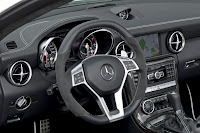
Functional, stylish, high-quality: the interior design of the SLK55 AMG is also reminiscent of its bigger brother, the SLS AMG Roadster. Associations with the super sports car are evoked courtesy of the four air vents in the style of jet engines, as well as the center console finished in brushed aluminum. Placed in the center of the dashboard is an AMG-specific analog clock featuring an IWC design. The AMG Performance steering wheel, with its flattened top and bottom sections, also boasts metal trim, aluminum shift paddles and grip areas finished in perforated leather. The clearly-arranged AMG instrument cluster is positioned perfectly in the driver’s field of vision and features four circular instruments, distinctive dials and the AMG main menu. The button for the transmission modes C, S and M is also located in the center console.
The AMG sports seats feature optimized lateral support and premium leather upholstery with AMG badges in the backrests and standard AIRSCARF necklevel heating system.
Magical: the panorama roof with MAGIC SKY CONTROL
The standard retractable hardtop opens and closes in less than 20 seconds, transforming the open-top Roadster into a closed-top Coupe with rigid roof at the touch of a button. Alternatively, a panorama roof panel in tinted polycarbonate can also be chosen. The third variant is a world premiere – the panorama roof with MAGIC SKY CONTROL. This glass roof switches to light or dark as required at the press of a button. When activated it is virtually transparent, offering an open-air experience even in cold weather. In its dark state the roof provides welcome shade and prevents the interior from heating up from the sun’s intense rays. In other words: a comfortable atmosphere at the touch of a button.
The frames of the three roof variants are made of magnesium. This makes each roof around 13 lbs lighter than in the previous model, giving the car a lower center of gravity – which benefits its agility. A comfortable alternative to the standard wind-stop is the new AIRGUIDE pivoting wind-stop. It consists of pivoting transparent plastic wings which are attached to the back of the rollover bars. The advantage: no installation or removal effort required.
Exceptional position: modern assistance systems on board
The 2012 SLK55 AMG sets new standards when it comes to safety: a whole host of the latest assistance systems support the driver and help secure the new AMG Roadster’s exceptional position in its segment. Standard equipment includes new, fiber-reinforced roll-over bar, two-stage driver and front passenger airbags, headbags, thorax airbags, knee airbags, seat belt tensioner with belt force limiters, NECK-PRO crash-active head restraints, three-stage ESP® and also ATTENTION ASSIST drowsiness detection.
Further assistance systems are available on request:
- DISTRONIC PLUS: this proximity control system automatically maintains a set distance from the vehicle ahead, braking the SLK55 AMG to a stop if necessary and also accelerating the Roadster again.
- The PRE-SAFE® Brake detects the acute danger of a rear-end collision and prepares for autonomous braking. The system is active at speeds of between 19 and 124 mph when moving vehicles are detected in front of the car.
Three generations: the SLK made by AMG
The 2012 SLK55 AMG is already the third generation of the exclusively dynamic Roadster model made by AMG. It all started in 2001 with the SLK32 AMG. Its supercharged AMG V6 engine with a displacement of 3.2 liters produced 349 hp and maximum torque 332 lb-ft – as such, the SLK32 AMG was the most powerful vehicle among the competition.
At the end of 2004 this was followed by the SLK55 AMG. With its AMG 5.5-liter V8 engine, which developed 355 hp and 376 lb-ft of torque, it also took the lead in its segment. No other vehicle in this class offers a large-displacement eightcylinder engine – and Mercedes-AMG has remained consistently true to this philosophy with the successor model. The new 2012 SLK55 AMG will celebrate its U.S. market launch in early 2012.